When you appoint more than one attorney in a Lasting Power of Attorney (LPA), you must choose how they make decisions: jointly (always together), jointly and severally (together or on their own), or jointly for some decisions and jointly and severally for others. For a Property and Financial Affairs LPA, we usually recommend jointly and severally, because joint attorneys run into real practical problems, and the whole LPA can end if one of them dies.
Key Takeaways
- Jointly means your attorneys must agree on every decision and all sign everything.
- Jointly and severally means any attorney can act alone, or they can act together.
- If a joint attorney dies and there's no replacement attorney, the LPA ends (Mental Capacity Act 2005, section 13).
- Joint attorneys often can't use online banking, debit cards or telephone banking for the donor's accounts.
- Whichever you choose, always appoint replacement attorneys.
What are the three ways your attorneys can act?
If you have more than one attorney, the law lets you appoint them to act jointly, jointly and severally, or jointly for some matters and jointly and severally for others (Mental Capacity Act 2005, section 10). The choice affects how easily they can manage your affairs, and what happens if one of them can no longer act.
| How they act | What it means | If one attorney dies |
|---|---|---|
| Jointly | They must always act together, agree every decision and all sign every document. | The LPA ends, unless a replacement attorney steps in. |
| Jointly and severally | They can act together, but any one of them can also act on their own. | The others carry on as normal. |
| Jointly for some decisions, jointly and severally for others | Some decisions need everyone to agree; for the rest, any attorney can act alone. | The others can still make the decisions they could make alone. Decisions that needed everyone fail, unless a replacement steps in. |
With the mixed option, for example, selling your home or decisions about medical treatment could need all your attorneys to agree, while day-to-day decisions, such as paying bills or your diet and what you wear, could be made by any one of them. You set out which decisions are which on continuation sheet 2.
If your LPA doesn't make clear how your attorneys are to act, the law assumes they are to act jointly (section 10), the most restrictive option of all.
What happens if a joint attorney dies?
If your attorneys were appointed to act jointly and one of them dies, the remaining attorney can't carry on alone, and the LPA ends (Mental Capacity Act 2005, section 13). The only way it can continue is if you appointed replacement attorneys at the outset.
If the LPA ends and you still have mental capacity, you would need to make a new one. If you've lost capacity, someone would have to apply to the Court of Protection to become your deputy. That's a slow and very expensive process, and it's easily avoided by appointing replacement attorneys when you make your LPA.
By comparison, if your attorneys were appointed jointly and severally, the death of one attorney ends only that attorney's appointment, and the others carry on as normal. If they were appointed jointly for some decisions and jointly and severally for others, the surviving attorney can still make the decisions that allowed any attorney to act alone, but the decisions that needed everyone fail unless a replacement steps in.
When an attorney dies, the surviving attorney should tell the Office of the Public Guardian (OPG) and send the death certificate. The OPG will then confirm whether the LPA continues, with the replacement, or has ended.
Why do joint attorneys struggle with the bank?
Because joint attorneys must always act together, banks have to make sure one attorney can't act without the other. In practice, that means many everyday conveniences aren't available to them:
- No online or mobile banking. Many banks don't give joint attorneys online access or banking apps, because digital tools work on single-user logins, which can't enforce two signatures.
- No individual debit cards. Many banks won't issue debit or cash cards to joint attorneys, as a card lets one person spend money without the other's consent.
- No telephone banking. Banks generally can't confirm over the phone, in real time, that both attorneys agree.
- Two signatures on everything. Every cheque, payment, account opening or closing, and every standing order or direct debit set up or cancelled, needs the signature of all the joint attorneys.
- Trips to the branch (if you can find one!). Many transactions have to be done in person, so all the attorneys can show identification and sign together.
- Delays with urgent payments. If a bill, care home fee or mortgage payment is due and one attorney is travelling, ill or can't be reached, the bank will refuse to make the payment on one signature.
What happens if joint attorneys disagree?
If joint attorneys can't agree, for example on whether to move money, close an account or pay a particular expense, nothing can happen. The bank can't act on conflicting instructions, or on instructions from just one attorney. The attorneys would have to try mediation or apply to the Court of Protection to settle the dispute, which can be costly and time-consuming.
Which option should you choose?
For a Property and Financial Affairs LPA with more than one attorney, we recommend appointing them to act jointly and severally. It lets any of your attorneys pay a bill or deal with the bank without waiting for the others, and it means your LPA carries on if one of them dies.
Appointing attorneys to act jointly can sometimes suit a Health and Welfare LPA, where you may want important decisions about your care made together. If you do, always appoint replacement attorneys too. Read more about the two types of LPA.
Why do replacement attorneys matter so much?
If your only attorney dies or can no longer act, and you haven't appointed a replacement attorney, your LPA can no longer be used. The same is true if a joint attorney dies. Naming one or two replacement attorneys at the outset costs nothing extra, and it's the simplest way to make sure your LPA keeps working when it's needed most.
How our Signing Guide helps
The more attorneys you have, the more signatures, witnesses and dates there are to get in the right order, and one date out of sequence is enough for the LPA to be sent back. That's why every LPA we prepare comes with a personalised Signing Guide. It lists who signs what and on which page, shows every signature box highlighted in yellow and every date box in blue, and reminds you to sign any continuation sheet, such as the one explaining which decisions your attorneys must make together, straight after section 9. If your attorneys act jointly and are applying to register the LPA, it shows each of them where to sign the application too. See two sample pages (PDF, fictional names).
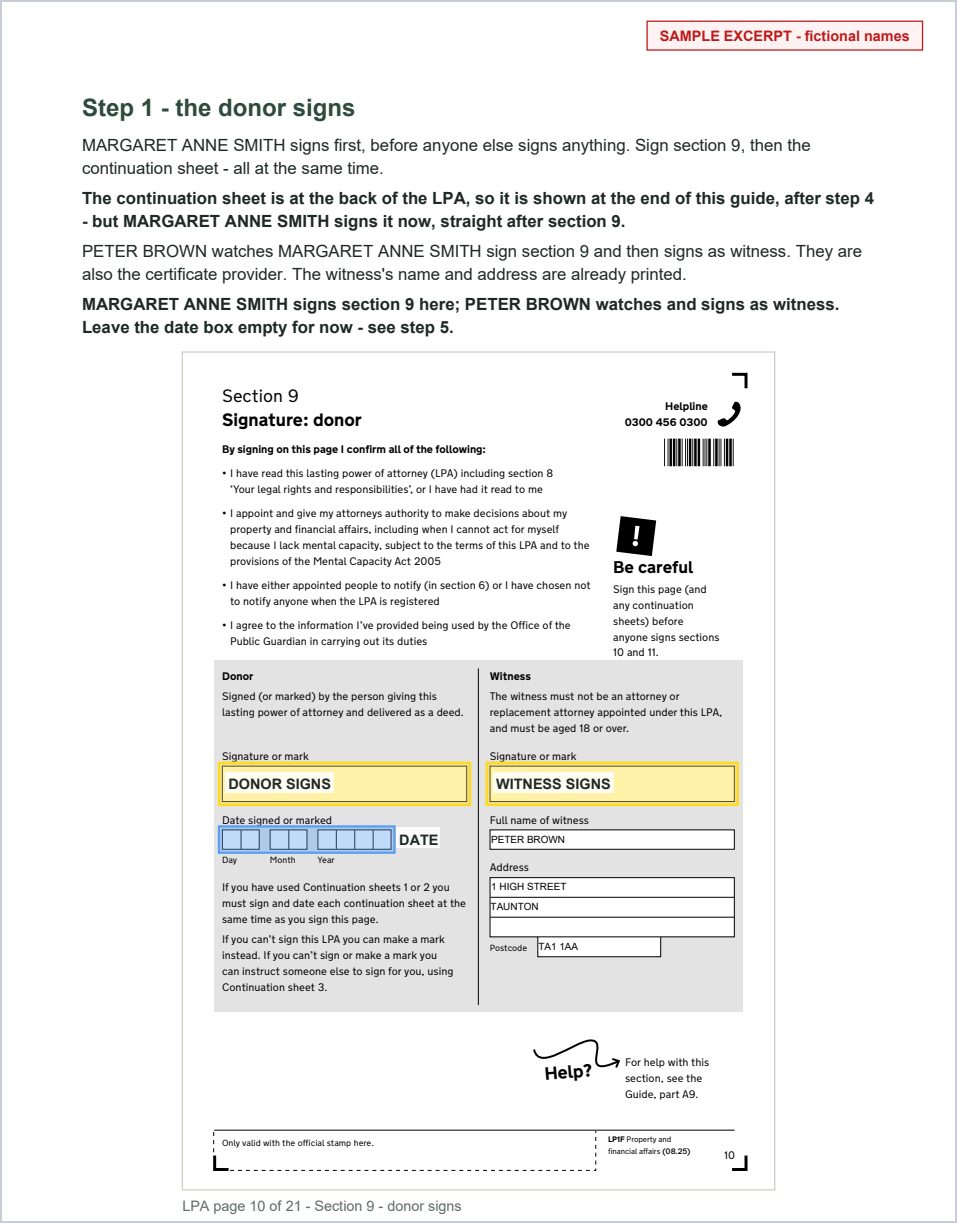
A page from a sample Signing Guide (fictional names). The donor's signature box is highlighted in yellow and the date box in blue, with a reminder to sign the continuation sheet straight after section 9.

Continuation sheet 2 from a sample Signing Guide, with the details blurred. If you choose for your attorneys to act jointly for some decisions and jointly and severally for others, we write the wording for you and the Signing Guide shows exactly where and when to sign it.
We fill in the forms, check them and give you the Signing Guide, so all you and your attorneys have to do is sign in the right places. Start your LPA
Plan your LPA with our free planning guide
Our free Lasting Power of Attorney planning guide walks you through every choice on the form, from your attorneys and replacements to your certificate provider and the signing order, with space to note everyone's details before you start.
Frequently asked questions
What does jointly and severally mean in an LPA?
It means your attorneys can make decisions together or on their own. Any one of them can act alone, so day-to-day things like paying bills don't need everyone's signature, and if one attorney dies the others carry on.
What happens to an LPA if a joint attorney dies?
If your attorneys were appointed to act jointly and one of them dies, the LPA ends, unless you named a replacement attorney who can step in. The remaining attorney can't carry on alone.
Can I mix jointly and jointly and severally?
Yes. You can say that your attorneys must act together on some decisions, such as selling your home, and can act on their own for everything else. You explain which decisions are which on continuation sheet 2.
What happens if I don't say how my attorneys should act?
The law assumes they are to act jointly, which is the most restrictive option. That's why it's important to choose clearly on the form.
Do joint attorneys all have to sign the application to register?
Yes. If your attorneys were appointed to act jointly and they are applying to register the LPA, they must all sign the application.
The short version: jointly and severally, with replacements
If you appoint more than one attorney for your money and property, let them act jointly and severally, and always name replacement attorneys. It keeps your LPA working day to day, and it stops one death bringing the whole LPA to an end.
Related guides: LPA continuation sheets · Why LPAs get rejected · Property and Financial Affairs vs Health and Welfare LPAs · Pension drawdown and lost capacity
About this guide
This guide was written and checked by the Downloadawill Will Team. It explains the current paper LPA process in general terms and isn't legal advice for your own situation. The Powers of Attorney Act 2023 is bringing in a new digital process, and we'll update this guide when it arrives. Downloadawill is a trading style of Direct Wills. All our Will Writers are Members of The Society of Will Writers. We've been writing Wills and Lasting Powers of Attorney for people in England and Wales since 1997. Read more about us.
Want your LPA checked before it goes to the OPG?
£75 per LPA · £140 for both · every LPA checked by our expert team · your own personalised Signing Guide, showing who signs where and in what order.
Start your LPA See all prices